
 ZH
ZH  EN
EN  ES
ES  FR
FR  DE
DE  RU
RU  AR
AR  RO
RO  BG
BG 
One of the most common questions in energy storage design is whether to choose an AC coupled 或 DC coupled solar + storage system.
Both solutions can improve energy independence, reduce electricity costs, and support backup power applications — but they work differently and are suitable for different project types.
AC Coupling vs DC Coupling
The biggest difference is where the battery storage system connects within the solar power system — either on the AC side or the DC side.
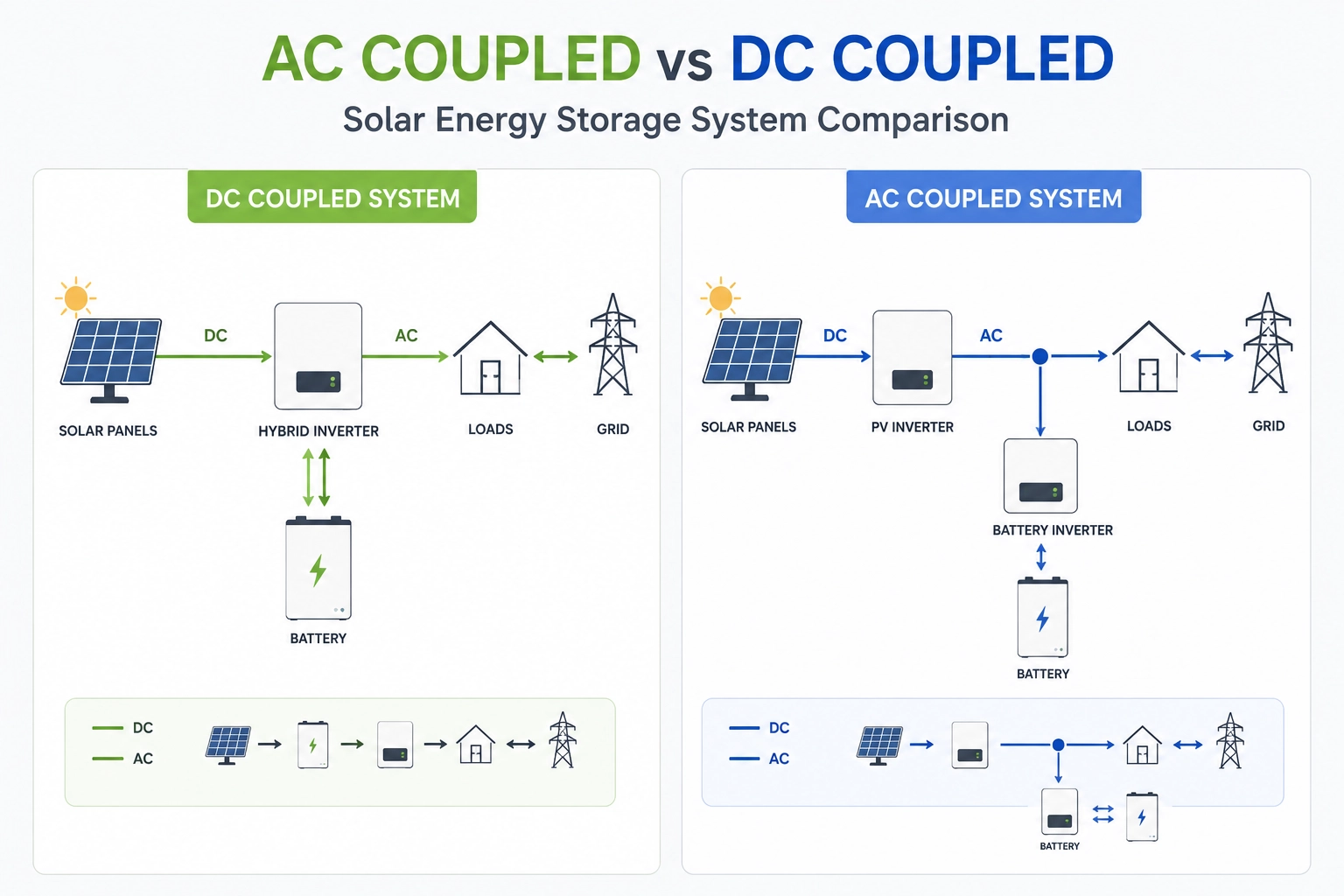
What Is a DC Coupled Solar + Storage System?
In a DC coupled system, the battery is connected directly on the DC side of the solar system before the inverter.
Solar panels generate DC electricity, which can charge the battery directly without first converting the power into AC electricity.
When electricity is needed for the building or the grid, the inverter converts the stored DC power into AC power.
Advantages of DC Coupled Systems
- Higher overall efficiency
- Lower conversion losses
- Simplified system architecture
- Lower equipment cost for new installations
- Well suited for hybrid inverters and off-grid systems
Limitations of DC Coupled Systems
- Less flexible for upgrading existing solar systems
- May require inverter replacement during retrofit projects
- Compatibility between components is more important
DC coupled systems are commonly used in newly designed solar + storage projects where efficiency and simplified design are priorities.
What Is an AC Coupled Solar + Storage System?
In an AC coupled system, the battery storage connects on the AC side of the system, usually after the solar inverter.
This means the solar panels and the battery system operate through separate inverters.
Solar energy is first converted from DC to AC by the solar inverter. If excess energy needs to be stored, the battery inverter converts the AC power back into DC for charging.
Advantages of AC Coupled Systems
- Easy integration with existing solar systems
- Flexible system expansion
- Independent solar and battery operation
- Suitable for large commercial and utility-scale ESS projects
- Easier future upgrades and scalability
Limitations of AC Coupled Systems
- More energy conversion steps
- Slightly lower efficiency compared to DC coupling
- Higher equipment complexity
AC coupled systems are widely used in commercial and industrial projects because they provide strong flexibility, scalability, and compatibility with existing grid-tied systems.
Efficiency Comparison: AC vs DC Coupling
The biggest technical difference between the two architectures is the number of power conversions.
| System Type | Energy Conversion Path | Typical Efficiency |
|---|---|---|
| DC Coupled | Solar → Battery → Inverter → Load | Higher |
| AC Coupled | Solar → Inverter → Battery → Inverter → Load | Slightly Lower |
Because DC coupled systems require fewer conversions, they usually achieve slightly higher round-trip efficiency. However, AC coupled systems provide greater flexibility and retrofit capability.
Which System Is Better for Your Project?
Choose DC Coupling If:
- You are building a new solar + storage system from scratch
- Maximum efficiency is the top priority
- You want a compact hybrid system
- The project is residential or small commercial
Choose AC Coupling If:
- You already have an existing solar PV system
- You plan to add battery storage later
- The project requires flexible expansion
- The project is commercial, industrial, or utility-scale
Why AC Coupled Systems Are Popular in Large Energy Storage Projects
For commercial and utility-scale applications, AC coupled energy storage systems have become increasingly common because they simplify integration with existing grid infrastructure and large solar power plants.
AC coupled architecture also makes it easier to scale battery capacity independently from solar generation capacity.
Bluesun provides large-scale AC coupled energy storage solutions for commercial and industrial applications, including:
These systems are designed for peak shaving, backup power, renewable integration, microgrid applications, and utility-scale energy management.
最終想法
There is no single “best” solution between AC coupled and DC coupled systems.
The ideal architecture depends on project type, installation stage, system size, efficiency goals, and future expansion requirements.
For new residential projects, DC coupled systems often provide better efficiency and lower hardware cost. For retrofit projects and large-scale commercial storage, AC coupled systems usually offer greater flexibility and scalability.
Understanding these differences early in the design process can help improve system performance, reduce installation complexity, and maximize long-term project value.