How to Choose the Right Solar Power System for Your Needs
Learn how to choose the right solar power system based on energy needs, location, budget, backup power requirements, and system type.
14/ 2025.Янв
Choosing the right solar power system is not only about selecting solar panels. A complete system should match your electricity consumption, installation environment, budget, grid conditions, and backup power needs.For homeowners, businesses, farms, and commercial buildings, the right system design can improve energy savings, reduce grid dependence, and provide more reliable power over the long term.
Quick Guide
The best solar power system depends on how you use electricity. On-grid systems are suitable for areas with stable grid power, off-grid systems work for remote locations, and hybrid systems are ideal when both grid connection and battery backup are needed.
Choosing the right solar power system starts with understanding your energy demand, grid conditions, and backup power requirements.
Start with Your Energy Needs
Before choosing a solar power system, you should first understand your electricity usage. A home, factory, farm, office building, or remote project may all require different system capacities and configurations.
Important questions include:
How much electricity do you use each day?
Do you need power only during the day or also at night?
Do you need backup power during outages?
Is the local utility grid stable?
Do you have enough roof or ground installation space?
Will your energy demand increase in the future?
These factors help determine system size, battery capacity, inverter type, and the overall system structure.
Understand the Main Types of Solar Power Systems
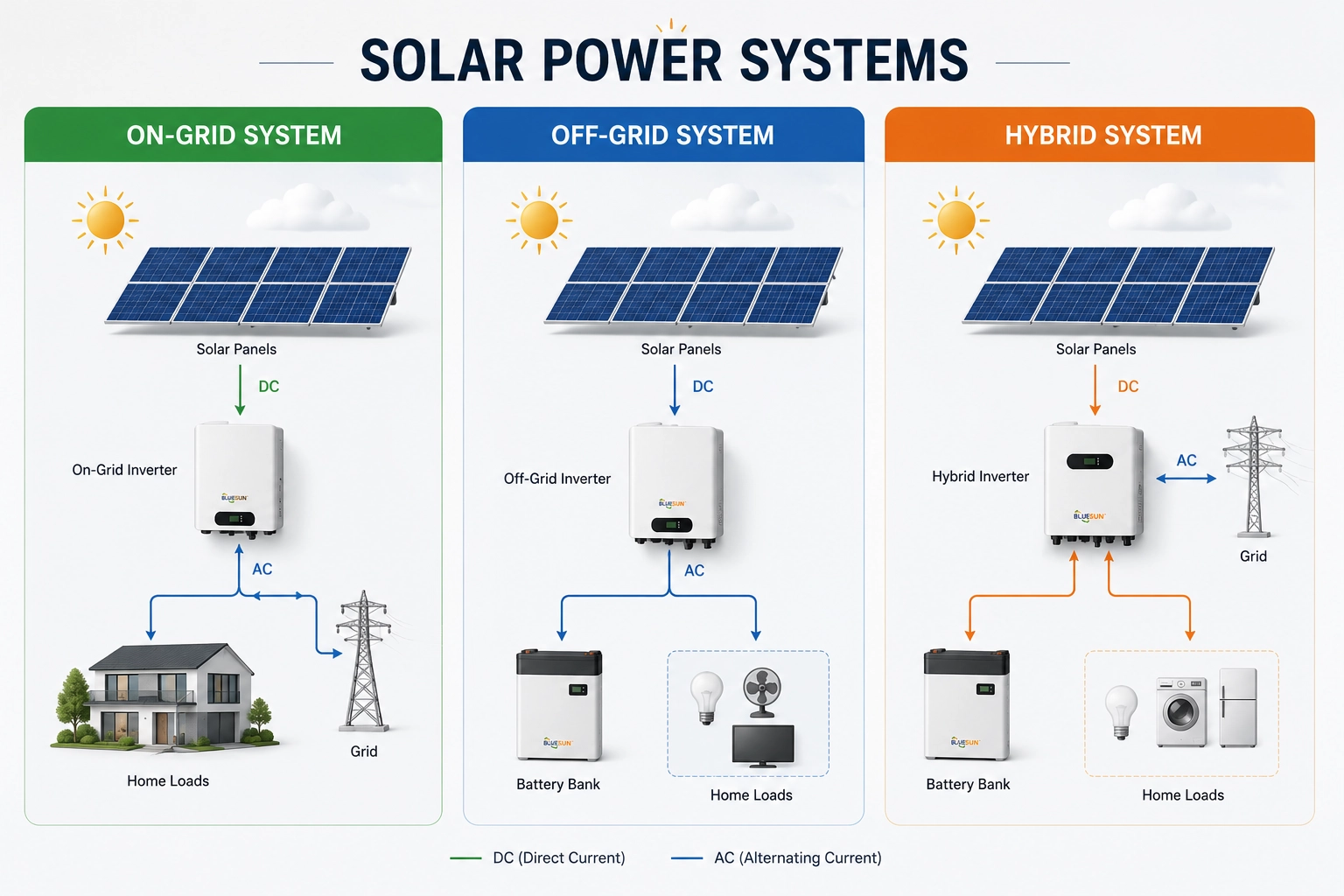
Solar power systems are usually divided into three main types: on-grid, off-grid, and hybrid. Each system type is designed for different usage scenarios.
System Type
Best For
Main Advantage
On-Grid Solar System
Homes and businesses with stable grid power
Lower electricity bills and simple system design
Внесетевая солнечная система
Remote areas without reliable grid access
Independent power supply with battery storage
Hybrid Solar System
Users needing both grid support and backup power
Flexible energy management with battery storage
When to Choose an On-Grid Solar System
An on-grid solar system is connected to the utility grid. It is commonly used in homes, offices, factories, and commercial buildings where grid power is stable.
This type of system helps reduce electricity bills by generating solar power during the day. When solar production is not enough, electricity can still be drawn from the grid.
On-grid systems are suitable when your main goal is reducing electricity costs rather than backup power.
When to Choose an Off-Grid Solar System
An off-grid solar system operates independently from the utility grid. It usually includes solar panels, an inverter, batteries, and system protection devices.
This system is suitable for remote homes, farms, islands, telecom sites, and areas where grid access is limited or unstable.
Because off-grid systems rely heavily on battery storage, proper system sizing is very important to ensure stable power supply during cloudy days or nighttime use.
When to Choose a Hybrid Solar System
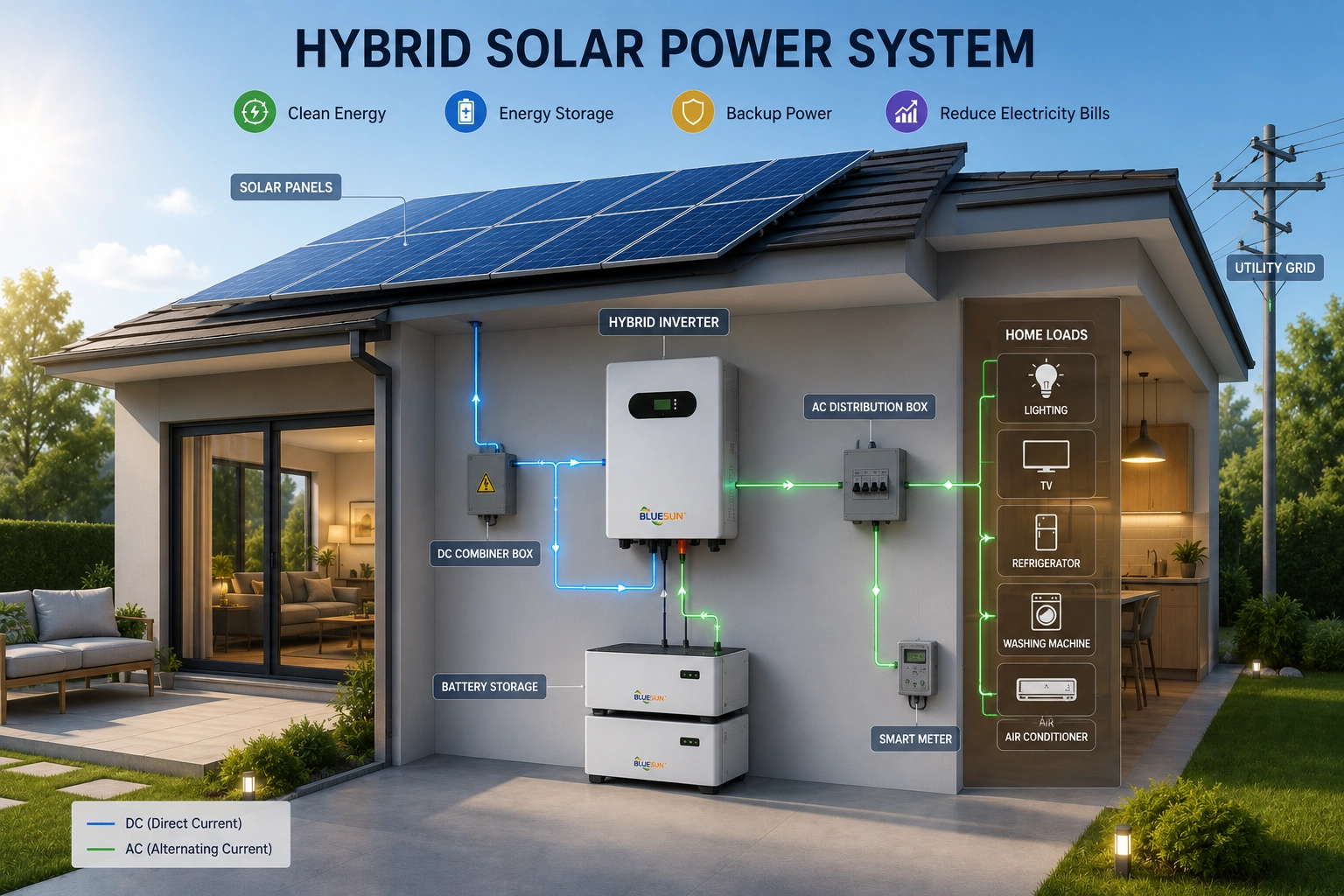
A hybrid solar system combines solar panels, battery storage, and grid connection. It provides more flexibility than a standard on-grid system.
During the day, solar panels generate electricity for immediate use and charge the battery. At night or during outages, stored energy can be used to support essential loads.
Hybrid systems are especially suitable for users who want lower electricity bills, improved energy independence, and backup power capability.
Battery Storage: Do You Need It?
Battery storage is becoming increasingly important in modern solar power systems. It allows users to store excess solar energy and use it later when sunlight is unavailable.
A lithium battery storage system can improve solar self-consumption and provide backup power for residential and small commercial applications.
Battery storage is recommended if you:
Need backup power during outages
Want to use solar energy at night
Have unstable grid conditions
Want to reduce peak electricity costs
Need a more independent energy solution
Residential vs Commercial Solar System Design
Residential and commercial solar systems have different design priorities. Residential systems usually focus on electricity bill savings, backup power, and limited roof space. Commercial systems often focus on larger capacity, return on investment, and long-term energy cost control.
For commercial projects, load profile, working hours, roof structure, grid policy, and future expansion plans should all be considered before system design.
Key Components to Consider
A high-quality solar power system depends on more than one component. The overall system performance is affected by solar panels, inverters, batteries, mounting structures, cables, protection devices, and monitoring systems.
Solar panels: determine electricity generation capacity.
Inverter: converts DC power into usable AC power.
Battery storage: stores excess solar energy for later use.
Mounting structure: supports safe and stable installation.
Monitoring system: helps track production and system performance.
A well-designed solar power system should match solar panels, inverter, battery storage, and monitoring according to actual project needs.
How to Choose the Right System Size
System size should be based on actual energy consumption, not only available roof space. A system that is too small may not meet electricity needs, while an oversized system may increase investment without improving returns.
To estimate system size, you should consider daily electricity consumption, peak load, sunlight hours, installation area, and backup time requirements.
For battery-based systems, battery capacity should also be calculated according to nighttime usage and backup power needs.
Bluesun Solar Power System Solutions
Bluesun provides on-grid, off-grid, and hybrid solar power system solutions for residential, commercial, industrial, and remote energy applications.
Our team can support system configuration based on project location, load requirements, installation space, battery storage demand, and long-term energy goals.
Explore Solar Power System Solutions
Bluesun provides complete solar power system solutions including solar panels, inverters, lithium batteries, mounting structures, and customized system design for global projects.
Explore Solar Power Systems
Choosing the Best Solar System for Your Project
The right solar power system depends on your real energy needs. If your grid is stable and your goal is electricity bill reduction, an on-grid system may be suitable. If you are in a remote area, an off-grid system may be necessary. If you need both grid connection and backup power, a hybrid system may be the better choice.
By choosing the right system type, capacity, inverter, and battery configuration, you can build a solar energy system that provides better performance, stronger reliability, and long-term value.
Ваш лучший поставщик фотоэлектрической аппаратурыКомпания Bluesun предлагает полный набор решений для солнечных фотоэлектрических систем которые могут оптимизировать широкий спектр проектных задач.


 RU
RU  EN
EN  ES
ES  FR
FR  DE
DE  ZH
ZH  AR
AR  RO
RO  BG
BG