
 RU
RU  EN
EN  ES
ES  FR
FR  DE
DE  ZH
ZH  AR
AR  RO
RO  BG
BG 
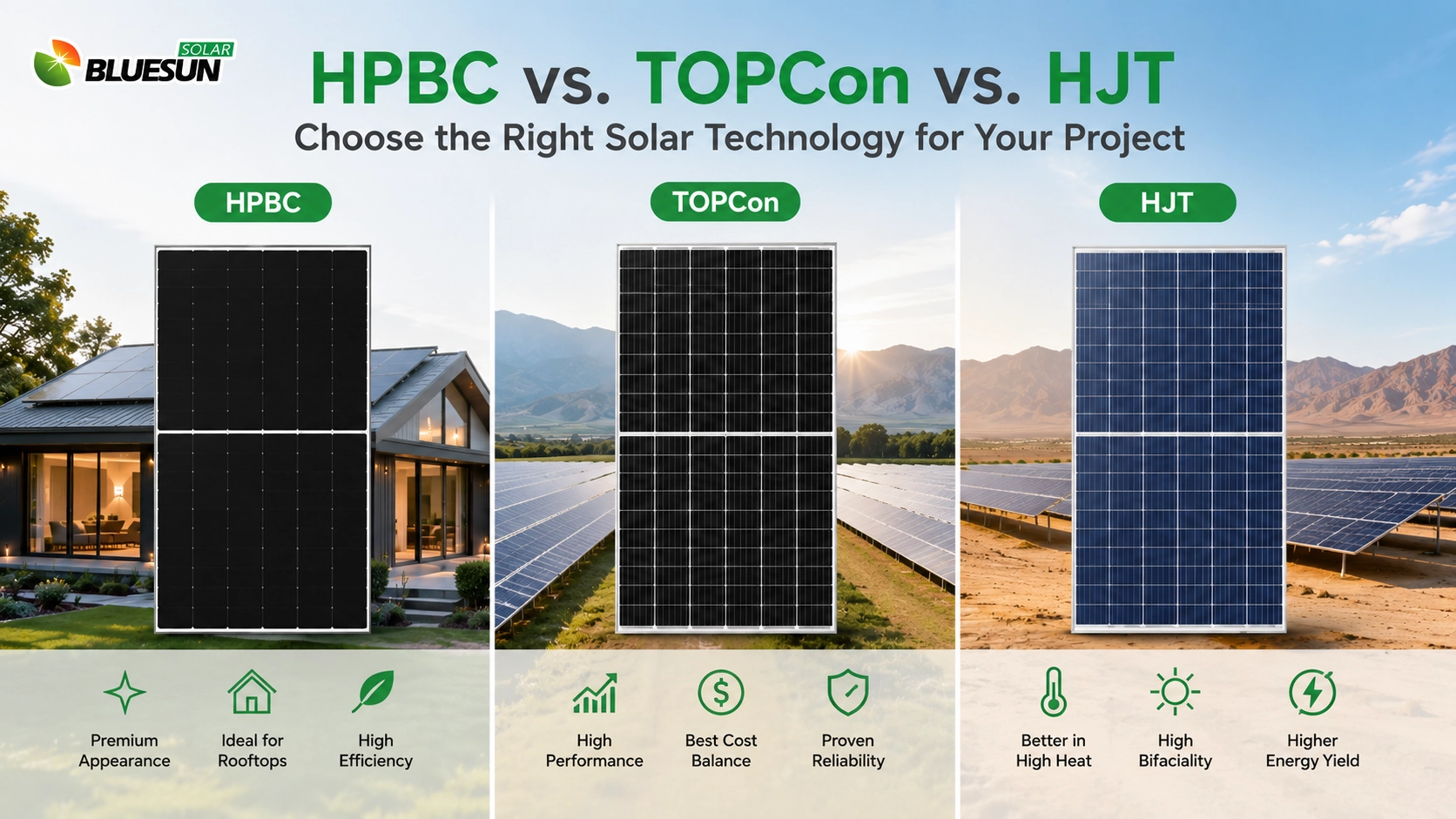
Some projects focus more on ROI and large-scale deployment, while others care more about high-temperature performance, bifacial generation, or rooftop appearance.
Because of this, choosing the right technology is often less about which one is “most advanced” and more about which one fits the actual project scenario.
Different Projects Prioritize Different Things
Utility-scale projects often focus on cost and energy yield, while residential rooftops may care more about appearance and space efficiency. Climate conditions can also affect which solar technology performs better over time.
Why TOPCon Has Become the Mainstream Choice
At the moment, TOPCon is the most widely adopted N-type solar technology in mass production.
One important reason is that TOPCon offers a relatively balanced combination of efficiency, manufacturing maturity, and cost control.
Compared with earlier PERC technology, TOPCon improves cell efficiency while still maintaining relatively scalable manufacturing.
This makes it especially suitable for:
- Utility-scale solar plants
- Commercial & industrial rooftop projects
- Large-volume deployment
- Projects focused on ROI and LCOE
TOPCon modules also offer strong bifacial performance, which is important for ground-mounted projects and reflective environments.
For many developers today, TOPCon solar panels represent the most practical balance between performance and cost.
Where HJT Technology Performs Best
HJT (Heterojunction Technology) is often discussed because of its strong electrical performance and excellent temperature behavior.
Compared with many conventional technologies, HJT modules generally perform better under high-temperature conditions and low-light environments.
HJT also offers very high bifaciality, which can help improve rear-side energy generation in certain installation environments.
Because of this, HJT technology is often considered for:
- High-temperature regions
- Desert projects
- Snow or high-reflection environments
- Premium utility-scale projects
However, HJT manufacturing cost is still relatively high compared with TOPCon, which affects large-scale market adoption in some price-sensitive regions.
For projects where maximum energy yield is a priority, HJT solar modules may offer additional long-term performance advantages.
Why HPBC Is Popular in Premium Rooftop Projects
HPBC technology focuses heavily on front-side appearance and light absorption efficiency.
Unlike conventional cell structures, HPBC places electrical contacts on the rear side of the cell, reducing front-side shading from metal grid lines.
This creates a cleaner all-black appearance that many residential users prefer.
HPBC modules are commonly used for:
- Крыши элитных жилых домов
- Премиальные проекты распределенной генерации
- Visible rooftop installations
- Projects with strong aesthetic requirements
Compared with TOPCon and HJT, HPBC is usually less focused on bifacial generation and more focused on front-side efficiency and rooftop aesthetics.
For projects where appearance and premium positioning matter, HPBC solar panels are becoming increasingly attractive.
Different Technologies Focus on Different Strengths
| Technology | Main Strength | Типовые применения |
|---|---|---|
| TOPCon | Balanced cost and efficiency | Utility-scale and C&I projects |
| HJT | High bifaciality and temperature performance | Hot climates and premium utility projects |
| HPBC | Appearance and front-side efficiency | Residential and premium rooftop systems |
Project Conditions Usually Matter More Than Marketing Claims
In the solar industry, there is rarely one technology that fits every project perfectly.
A utility-scale project in the Middle East may prioritize temperature coefficient and bifacial gain, while a residential rooftop project in Europe may care more about appearance and limited installation space.
This is why module selection should usually be based on:
- Project type
- Climate conditions
- Installation environment
- Budget expectations
- Long-term energy yield goals
In many cases, project economics and installation conditions are more important than theoretical efficiency differences alone.
N-Type Technology Is Still Evolving
TOPCon, HJT, and HPBC all represent different development directions within N-type solar technology.
As manufacturing continues improving, these technologies will likely keep evolving in efficiency, cost control, and application flexibility.
For developers, EPC companies, and distributors, understanding the practical strengths of each technology is becoming increasingly important when selecting modules for different project scenarios.