
 AR
AR  EN
EN  ES
ES  FR
FR  DE
DE  RU
RU  ZH
ZH  RO
RO  BG
BG 
Shingled Technology Changed Traditional Module Design
Instead of using full solar cells connected by visible ribbons, shingled modules use overlapping cell strips connected with electrically conductive adhesive, creating a cleaner and more compact layout.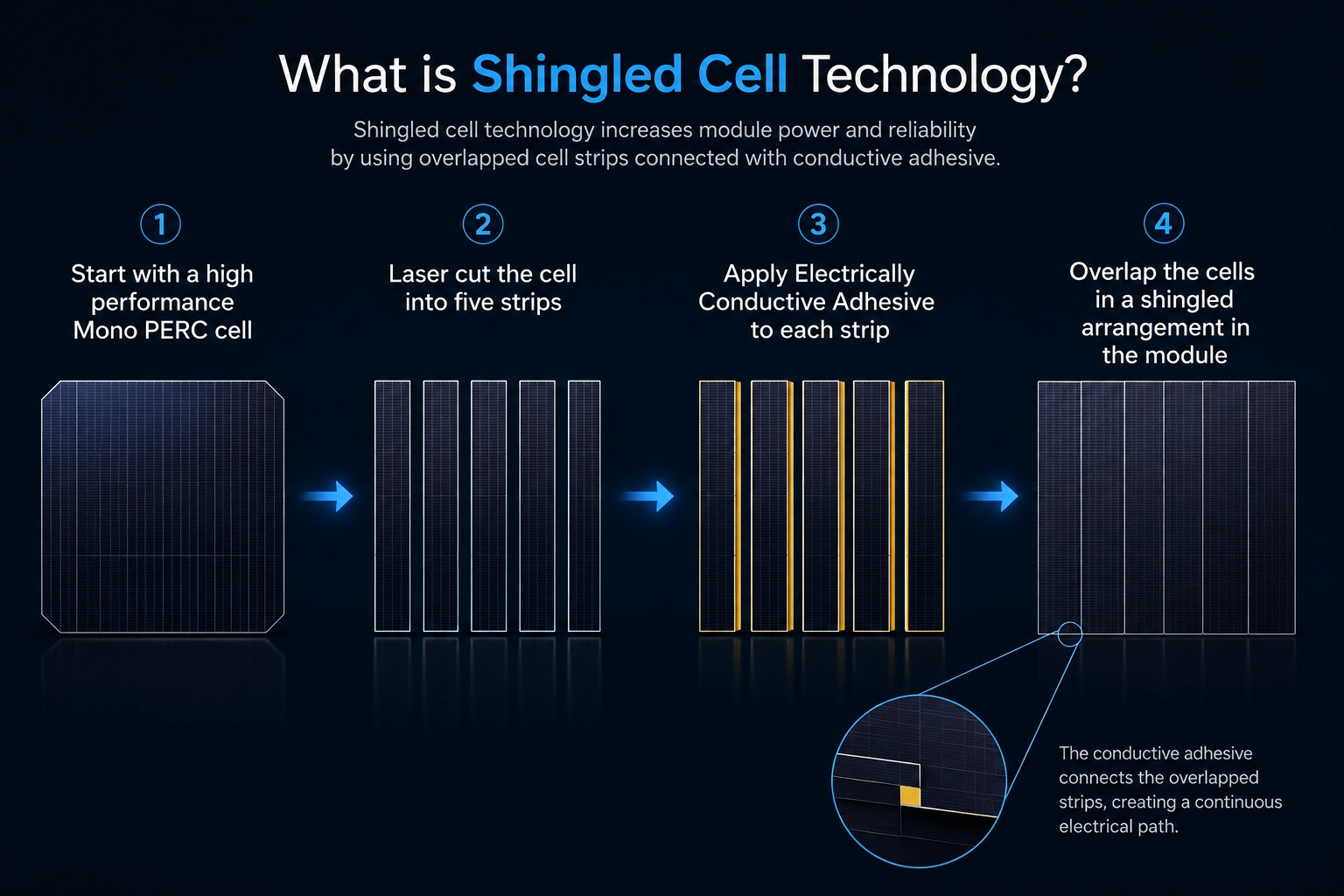
What Are Shingled Solar Panels?
Shingled solar panels are designed by cutting solar cells into smaller strips and overlapping them in a layout similar to roof shingles. Unlike conventional modules that use metal ribbons to connect cells, shingled modules typically rely on electrically conductive adhesive (ECA) for cell interconnection. This structure reduces gaps between cells and allows more active cell area within the same module size. The result is a solar panel with a cleaner appearance and potentially higher energy density.Advantages of Shingled Solar Panels
Higher Module Density
One of the biggest advantages of shingled technology is improved space utilization. Because the cells overlap slightly, there is less inactive spacing inside the module. This helps increase overall module power output within the same physical dimensions.Improved Aesthetics
Shingled panels are often visually cleaner than traditional modules because they eliminate many visible ribbon lines and large cell gaps. This made them especially attractive for residential rooftops and architectural solar projects where appearance matters.Better Partial Shading Performance
Many shingled designs use multiple parallel current paths, which can help reduce power loss caused by partial shading. In certain installation environments, this structure may improve energy generation consistency compared with some traditional layouts.Reduced Mechanical Stress
Using conductive adhesive instead of traditional soldering may reduce thermal stress on solar cells, lowering the risk of microcracks under some operating conditions.Challenges of Shingled Technology
While shingled solar panels introduced several innovative advantages, the technology also faced some practical challenges.More Complex Manufacturing
Shingled modules require precise cell cutting, alignment, and adhesive application during production. This increases manufacturing complexity compared with more conventional module assembly methods.Higher Production Costs
Because of the more specialized production process, shingled modules were often more expensive to manufacture than standard solar panels. As the market became increasingly cost-competitive, production scalability became an important factor.Repair and Maintenance Limitations
Due to the overlapping cell structure and adhesive-based connections, repair processes for damaged shingled modules can be more difficult compared with conventional designs.How Solar Module Technology Continues to Evolve
As photovoltaic technology continues advancing, the industry has gradually shifted toward newer high-efficiency cell architectures focused on better energy density, improved appearance, and long-term performance. Modern module development is no longer only about increasing wattage. Manufacturers are also focusing on reliability, lower degradation, optimized energy generation, and cleaner module aesthetics. For projects seeking premium module appearance and advanced cell architecture, technologies such as HPBC solar modules are becoming increasingly popular in residential, commercial, and high-end rooftop applications.Industry trend: Solar module competition is increasingly focused on efficiency, long-term reliability, energy density, and modern module design rather than only maximum power output.