
 AR
AR  EN
EN  ES
ES  FR
FR  DE
DE  RU
RU  ZH
ZH  RO
RO  BG
BG 
Because of this, storage duration is becoming just as important as total battery capacity.
ESS Capacity and ESS Duration Are Not the Same Thing
Many people focus only on battery capacity (MWh), but the discharge duration of the system often has a much bigger impact on how the ESS performs in real operating conditions.
What Does a 4-Hour ESS Actually Mean?
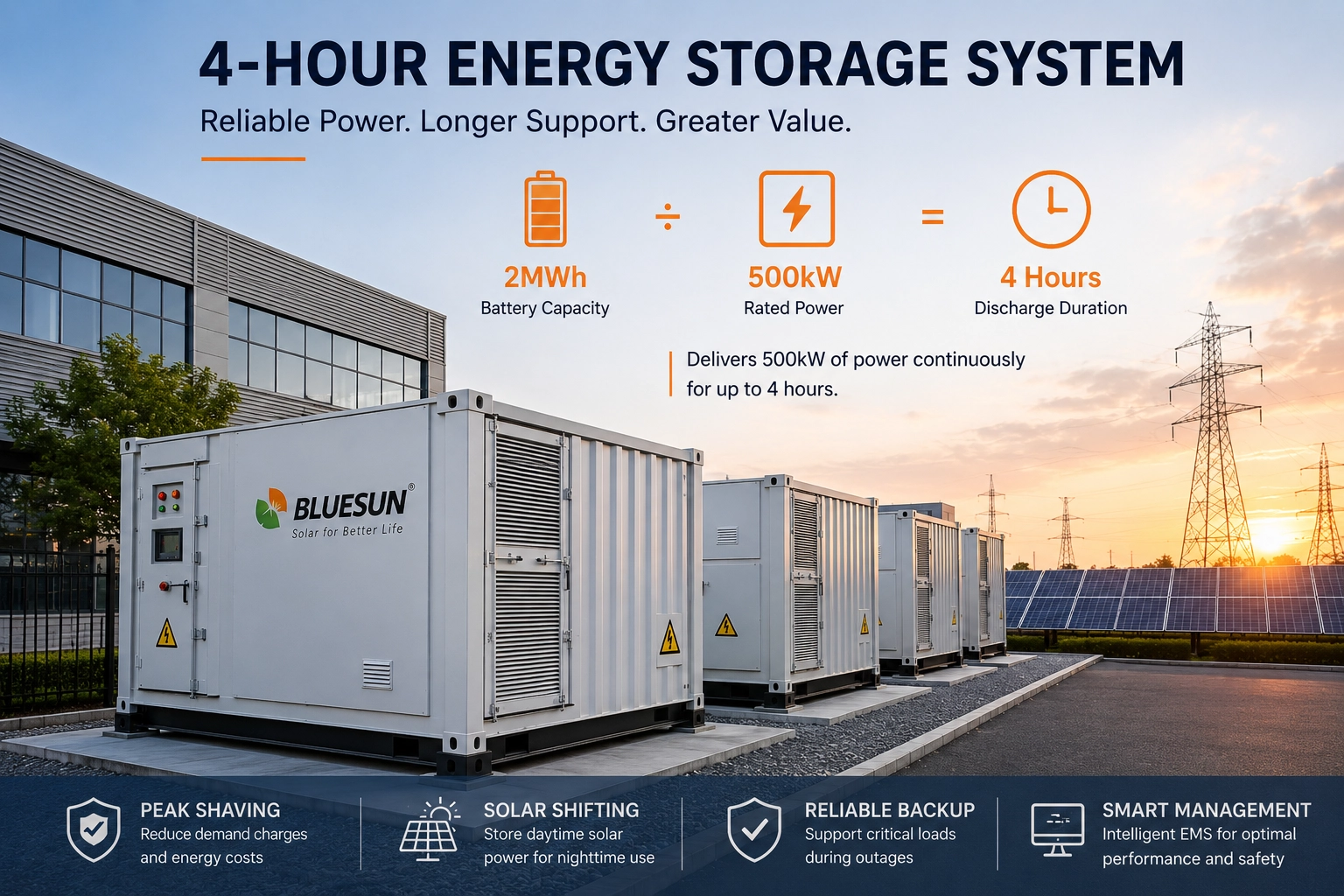
The term “4-hour ESS” refers to how long the battery system can continuously discharge electricity at its rated output power.
على سبيل المثال:
In this case, the system can supply 500kW of power continuously for approximately 4 hours.
This operating duration is becoming increasingly popular because many commercial facilities experience peak electricity demand for several consecutive hours rather than only short spikes.
Why Businesses Are Moving Beyond Short-Duration ESS
Short-duration systems can still work well for emergency backup or brief peak demand reduction.
However, as electricity pricing structures become more complex, businesses are increasingly looking for systems that can support longer discharge periods during expensive evening peak hours.
Longer-duration ESS also improves solar energy utilization by storing excess daytime solar generation and shifting it into nighttime operation.
Common drivers include:
- Peak electricity price management
- Solar energy shifting
- Reducing diesel generator runtime
- Microgrid operation
- Grid instability support
- Longer backup power requirements
Industrial Facilities Often Benefit from Longer Storage Duration
Factories and industrial facilities often operate under continuous or semi-continuous load conditions.
In many cases, electricity demand remains high for several hours rather than fluctuating only briefly.
Because of this, 4-hour ESS configurations are becoming more practical for:
- Manufacturing plants
- Mining operations
- Industrial parks
- Logistics centers
- Large commercial buildings
Longer-duration ESS configurations are especially useful for projects that require stable nighttime operation or extended peak shaving periods.
Solar + Storage Projects Are Also Driving Longer ESS Duration
As solar PV capacity increases, many businesses are discovering that short-duration battery systems are sometimes unable to fully utilize excess daytime solar generation.
A longer-duration ESS allows more solar energy to be shifted into evening operation instead of being curtailed or exported at low value.
This is especially important for facilities with large daytime solar production and high nighttime electricity demand.
Businesses planning larger containerized ESS systems are increasingly evaluating storage duration based on actual operating schedules instead of only comparing battery size.
Why AC Coupled ESS Works Well for Larger Projects
Many longer-duration commercial ESS projects now use AC coupled architecture because it allows solar generation and battery storage systems to operate more flexibly.
This is particularly useful for projects that may expand over time or retrofit storage into existing solar systems.
AC coupling also makes it easier to increase battery capacity independently as operating requirements change.
If you want to better understand the difference between AC and DC coupling architecture, you can also read our article on AC Coupled vs DC Coupled Solar + Storage Systems.
Containerized ESS Is Becoming More Common for Long-Duration Storage
As ESS projects increase in scale, containerized systems are becoming increasingly common because they simplify deployment, maintenance, transportation, and future expansion.
Integrated systems combining battery storage, thermal management, PCS, EMS, and fire protection are now widely used for commercial and industrial applications.
Modular ESS architecture also makes it easier for businesses to gradually expand storage duration as operating requirements evolve over time.
What Businesses Are Paying More Attention to
Compared with earlier ESS projects that focused mainly on installed battery capacity, businesses are now paying much more attention to actual operating strategy.
Instead of asking only “How large is the battery?”, many project owners are now asking:
- How long can the ESS support critical loads?
- Can the system cover evening peak pricing periods?
- Will the ESS still meet operational needs after future expansion?
- How efficiently can solar generation be shifted throughout the day?
Because of this, storage duration is becoming one of the most important considerations in commercial ESS planning.