How Modern LiFePO4 Batteries Balance Fast Charging and Long Lifespan
Discover how modern LiFePO4 batteries balance fast charging performance with long cycle life for solar energy storage and off-grid power systems.
11/ 2025.نوفمبر 2025
As solar energy storage systems continue becoming more common, users are paying closer attention to charging performance.In many situations, available charging time is limited. Cloudy weather, unstable grid conditions, and peak electricity pricing all increase the importance of charging batteries more efficiently.
At the same time, users still expect batteries to operate reliably for many years without major capacity loss.
This balance between charging speed and long-term durability is becoming an important direction in modern energy storage system design.
Fast Charging Is Important — But Stability Still Matters
Modern solar storage systems are no longer only focused on storing energy. They also need to charge efficiently while maintaining long-term battery health and stable daily operation.
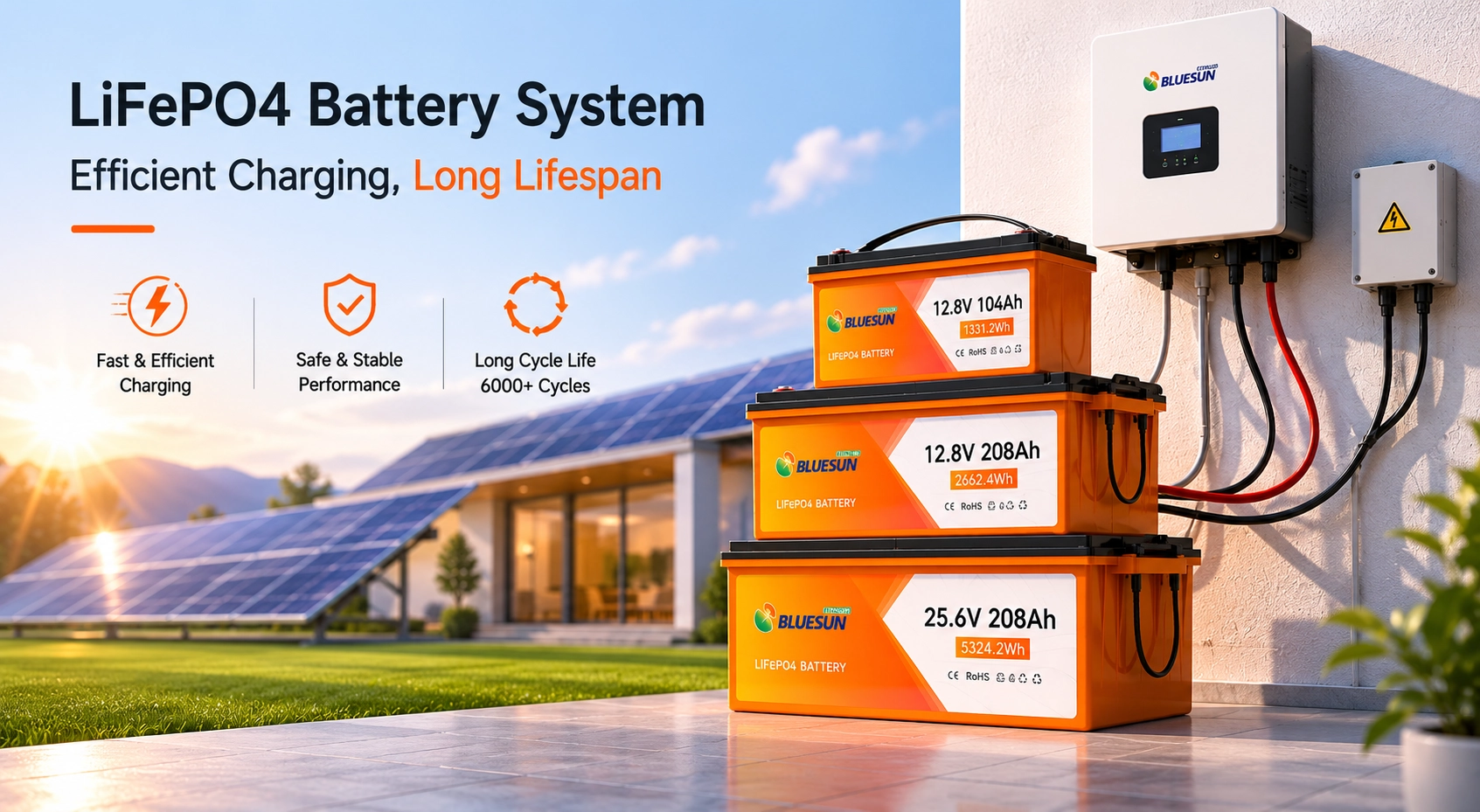
Modern LiFePO4 battery systems are designed to balance charging efficiency, thermal stability, and long-term cycle performance.
Why Faster Charging Matters in Solar Systems
In real solar applications, charging conditions are not always ideal.
Some regions only have a limited number of effective sunlight hours each day. In commercial systems, batteries may also need to charge during off-peak electricity periods before being discharged later during peak demand.
Because of this, charging efficiency directly affects how much usable energy can actually be stored within a limited time window.
For off-grid systems and backup applications, efficient charging can also help improve energy availability during unstable weather conditions.
Fast Charging Alone Is Not Enough
Although charging speed is important, simply increasing charging power is not always the best solution.
Excessive charging stress can increase battery temperature, accelerate aging, and reduce long-term stability if the battery system is not properly designed.
This is one reason why battery management and thermal stability are becoming increasingly important in modern energy storage systems.
In practical operation, the goal is not only faster charging, but stable charging.
Why LiFePO4 Batteries Are Widely Used in Solar Storage
LiFePO4 batteries have become increasingly common in solar energy storage because they offer a balanced combination of safety, cycle life, and charging performance.
Compared with older battery technologies, LiFePO4 chemistry provides:
Better thermal stability
Longer cycle life
Higher charging efficiency
More stable long-term performance
Lower maintenance requirements
These characteristics make LiFePO4 batteries especially suitable for solar systems that charge and discharge frequently.
Battery Management Systems Play a Big Role
Charging performance is not only determined by the battery cells themselves.
The Battery Management System (BMS) also plays an important role in protecting battery health and maintaining charging stability.
A well-designed BMS helps manage:
Charging current
Cell balancing
Temperature protection
Voltage control
Overcharge prevention
These functions help improve both charging safety and long-term battery reliability.
Temperature Control Is Often Overlooked
Battery temperature has a direct impact on charging behavior and overall lifespan.
In high-temperature environments, excessive charging stress can accelerate battery aging. In low-temperature conditions, charging efficiency may also decrease.
This is one reason why many modern energy storage systems include thermal management and intelligent charging control strategies.
Stable operation over time is usually more important than pursuing charging speed alone.
How Energy Storage Systems Are Evolving
As solar and storage systems continue evolving, users are no longer only comparing battery capacity.
More attention is now being given to:
Charging efficiency
System lifespan
Thermal stability
Long-term operating cost
Daily energy management performance
This is also why many modern LiFePO4 battery systems are designed around intelligent charging logic and long-term operational stability rather than simply pursuing maximum charging speed.
The Future of Solar Storage Is About Balance
In solar energy storage, faster charging and long battery lifespan are both important.
The challenge is finding the right balance between efficiency, safety, and long-term reliability.
Modern LiFePO4 battery technology is helping move the industry in that direction — allowing solar systems to charge more efficiently while still maintaining stable long-term performance for residential, commercial, and off-grid energy applications.


 AR
AR  EN
EN  ES
ES  FR
FR  DE
DE  RU
RU  ZH
ZH  RO
RO  BG
BG