
 AR
 EN
 ES
 FR
 DE
 RU
 ZH
 RO
 BG

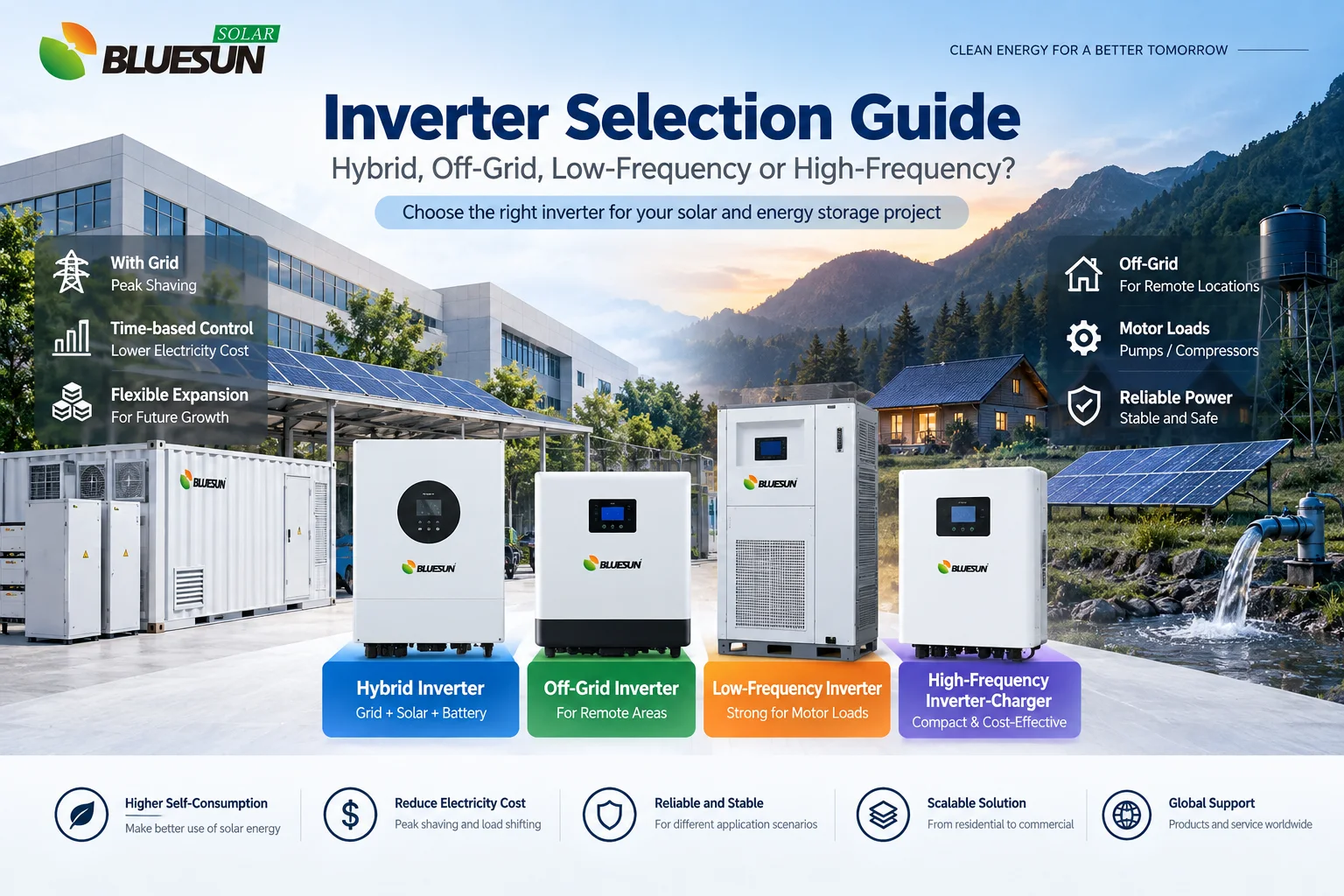
Choosing the right inverter for a solar and battery storage project is not simply a matter of matching inverter power with the total load.
In real projects, problems such as overload trips, unstable parallel operation, limited charging and discharging control, or difficulty expanding the system often come from decisions made during the inverter selection stage.
The most common questions are usually straightforward:
- Should the project use a hybrid inverter or a pure off-grid inverter?
- For an off-grid system, should you choose a low-frequency transformer inverter or a high-frequency inverter-charger?
- What happens if the site includes pumps, motors or other loads with high starting current?
The answer depends on the actual site conditions — especially grid availability, load type, battery operating strategy and future expansion requirements.
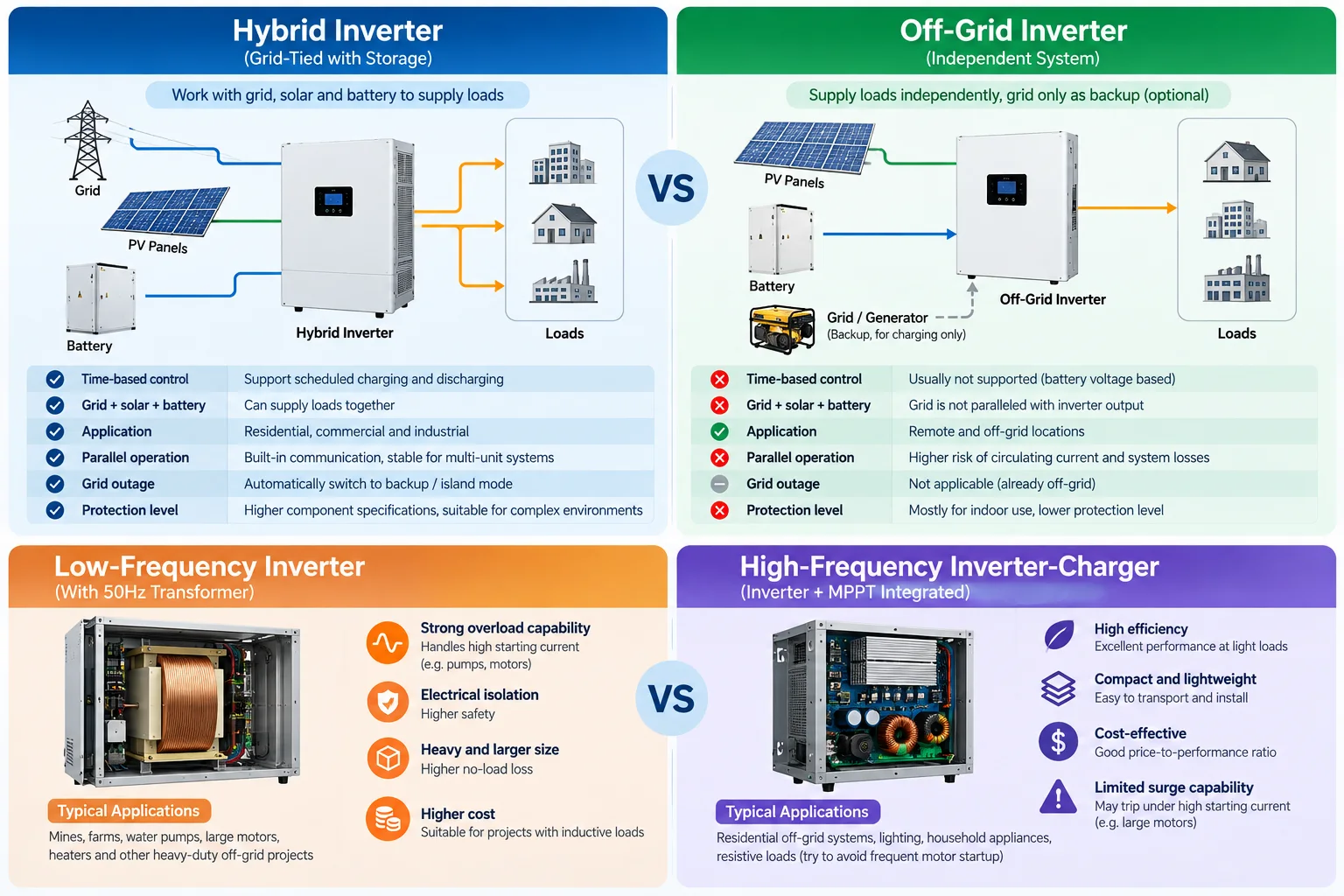
Hybrid Inverter vs Off-Grid Inverter: What Is the Real Difference?
Hybrid and off-grid inverters are sometimes treated as similar products because both can work with batteries.
In practice, however, the way they interact with the grid, battery and loads can be very different.
1. Hybrid Inverters Can Support Time-Based Energy Management
One of the main advantages of a hybrid inverter is the ability to manage battery charging and discharging according to a defined operating schedule.
For example, the system can charge the battery during a selected period and discharge it later when electricity demand or electricity prices are higher.
This makes hybrid inverters more suitable for applications such as:
- Peak shaving
- Load shifting
- Time-of-use energy management
- Increasing solar self-consumption
A conventional pure off-grid inverter usually follows a simpler control strategy based mainly on battery conditions, solar availability and configured voltage or SOC limits.
If the customer needs more flexible battery scheduling, the difference becomes important before the system is installed.
2. Hybrid Systems Can Work with Grid, Solar and Battery Together
A hybrid inverter can operate while connected to the utility grid and coordinate energy from solar, battery and grid sources.
For example, consider a site with a total load of 15kW.
If the inverter is supplying 5kW, the remaining demand may be supplied by the grid depending on the inverter architecture and operating mode.
This means the inverter does not necessarily need to carry the entire site load by itself at every moment.
A typical pure off-grid inverter works differently. The grid or generator, if connected, normally acts as an auxiliary or backup source rather than operating in parallel with the inverter output to share the same load in the same way.
3. Backup Operation Is Different
A hybrid inverter can normally operate while connected to the grid and switch to backup or islanded operation when the grid fails, provided the system includes the correct battery and backup output configuration.
Solar and battery power can then continue supplying selected critical loads.
A pure off-grid inverter is already designed to operate independently from the public grid, so it does not use the same grid-connected-to-backup transition logic.
4. Parallel Expansion Needs to Be Considered Early
A small system using one inverter is usually relatively straightforward.
The situation becomes more complex when several inverters need to operate in parallel.
Multi-inverter systems depend on communication, synchronization and balanced current sharing between each unit.
If the inverter platform is not designed for stable parallel operation, adding more units can increase circulating current, losses and control complexity.
For commercial and industrial projects that may expand later, it is therefore better to consider parallel capability during the initial system design rather than after the system reaches its power limit.
5. Installation Environment Also Matters
Inverter selection should also consider where the equipment will actually be installed.
Different inverter models may have different enclosure protection levels, cooling designs and environmental requirements.
A product designed mainly for indoor installation should not automatically be treated the same as equipment designed for outdoor or more demanding commercial environments.
Quick Tip: When Is a Hybrid Inverter the Better Choice?
If the site has utility power and needs scheduled battery operation, peak shaving, grid interaction or future system expansion, a hybrid inverter is usually the more practical starting point.
If there is no grid connection at all, a dedicated off-grid system may be more appropriate.
Low-Frequency vs High-Frequency Inverter-Charger
Choosing an off-grid inverter does not finish the selection process.
Another important decision is whether the project needs a low-frequency transformer-based inverter or a high-frequency inverter-charger.
This becomes especially important when the load includes pumps, compressors, motors or other equipment with large starting currents.
Low-Frequency Transformer Inverters
A low-frequency inverter typically uses a large 50Hz transformer inside the unit.
Because of this transformer, the equipment is usually larger and heavier than a high-frequency design.
Its main advantage is strong short-term overload and surge capability.
This makes low-frequency inverters suitable for loads such as:
- Large water pumps
- Motors
- Compressors
- Mining equipment
- Agricultural machinery
- Other loads with high startup current
Depending on the inverter design, the transformer can also provide electrical isolation between the AC and DC sides.
The trade-off is size, weight and operating loss. Low-frequency units can have higher no-load consumption, lower efficiency under light-load conditions and a higher equipment cost.
For demanding off-grid applications, however, their stronger surge capability can be much more important than compact size.
High-Frequency Inverter-Chargers
A high-frequency inverter-charger uses a more compact electronic design and often integrates the inverter and MPPT solar charge controller into one unit.
This generally makes the equipment smaller, lighter and easier to install.
High-frequency inverter-chargers are well suited to many residential and small off-grid applications with loads such as:
- Lighting
- Televisions
- Computers
- Household appliances
- Other relatively stable resistive loads
They also tend to offer a good balance between efficiency, size and cost.
The main point to check carefully is surge capability.
A large motor may require several times its normal running current during startup. If the inverter cannot provide enough short-term power, it may trigger overload protection even when the motor's rated running power appears to be within the inverter's nominal capacity.
Why Motor Loads Need Special Attention
One of the most common mistakes in inverter sizing is looking only at the rated power printed on the load.
A 10kW motor and a 10kW resistive heater do not behave the same way.
The heater is mainly a steady resistive load. A motor, however, can draw significantly more current during startup before settling at its normal operating level.
This startup surge may last only a short time, but it can still be enough to trigger inverter overload protection.
That is why projects involving pumps, compressors or large motors should consider:
- Continuous load power
- Starting current
- Inverter surge rating
- Motor starting method
- Whether several motors may start at the same time
Do Not Size an Inverter Only by Adding Up the Loads
Adding together the rated power of all loads is a useful starting point, but it is not the complete sizing process.
The inverter also needs enough operating margin for simultaneous loads, temporary fluctuations and real site conditions.
Consider a practical example.
A customer has six electric heaters with a combined resistive load of 84kW.
If all six heaters can operate at the same time, adding a 20% design margin gives:
84kW × 1.20 = 100.8kW
In this case, a 125kW three-phase hybrid inverter provides more practical operating headroom than selecting an inverter too close to the calculated 84kW load.
For a three-phase system, phase balance must also be considered.
Even if the total power remains within the inverter rating, severe imbalance between the three phases may still lead to operating problems.
Be Careful with Multiple Off-Grid Inverters in Parallel
Using several smaller off-grid inverters in parallel may appear to be an easy way to increase system power.
However, the total system capability is not simply the sum of the nameplate ratings.
Parallel operation also depends on:
- Communication between units
- Synchronization
- Current sharing
- Control strategy
- Cable and busbar design
- Protection coordination
If these factors are not handled correctly, multi-unit systems may experience circulating current, higher losses or unstable operation.
For larger commercial systems, selecting a platform specifically designed for multi-unit parallel operation is usually safer than simply adding many standalone off-grid inverters.
Quick Inverter Selection Guide
| Site Condition | Recommended Direction |
|---|---|
| Grid available, scheduled charging and discharging required | العاكس الهجين |
| Grid available, peak shaving or future expansion required | العاكس الهجين |
| No grid, large pumps or motors with high startup current | Low-frequency transformer inverter |
| No grid, mainly lighting and household appliances | High-frequency inverter-charger |
| Large system requiring several inverters in parallel | Choose a platform designed for coordinated parallel operation |
Questions to Ask Before Selecting an Inverter
Before choosing a specific inverter model, start with the project rather than the product catalog.
Ask the following questions:
- Does the site have utility grid power?
- Is the grid stable or frequently interrupted?
- Does the battery need scheduled charging and discharging?
- Is peak shaving required?
- Are there large pumps, motors or compressors?
- What is the maximum simultaneous load?
- Is backup power required?
- Will the system need to expand later?
- Will multiple inverters need to operate in parallel?
- What are the actual installation conditions?
These questions usually tell you more about the correct inverter type than the nominal power rating alone.
Hybrid, Off-Grid, Low-Frequency or High-Frequency: Which One Should You Choose?
There is no single inverter architecture that is best for every solar and battery project.
A hybrid inverter is generally better suited to sites that have grid access and require more flexible energy management, battery scheduling, backup operation or future expansion.
For fully off-grid projects, load type becomes especially important.
If the project includes large motors, pumps or high startup currents, a low-frequency transformer inverter may provide the stronger surge capability required by the site.
If the project mainly supplies lighting, household appliances and relatively stable loads, a high-frequency inverter-charger can provide a more compact and cost-effective solution.
The key is to match the inverter to the actual operating conditions instead of selecting it only by power rating.
Final Thoughts
The inverter is one of the core power conversion and control components in a solar energy storage system.
A good selection should consider grid conditions, load characteristics, surge current, battery operating strategy, backup requirements, parallel capability and future expansion from the beginning.
Getting these decisions right during the design stage can help reduce overload trips, unstable parallel operation and unnecessary system changes after installation.
For real projects, the best inverter is not necessarily the largest or most expensive model — it is the one that matches the actual load, grid conditions and operating requirements of the site.