
 RO
RO  EN
EN  ES
ES  FR
FR  DE
DE  RU
RU  ZH
ZH  AR
AR  BG
BG 
When businesses ask about commercial battery storage, the first question is often simple: How much does a BESS cost?
The difficult part is that there is no single price that applies to every project. A 500kWh outdoor battery cabinet installed beside a factory is very different from a 500kWh system that also requires a transformer, new switchgear, civil construction and complex grid protection.
The battery capacity may be the same, but the final project cost can be very different.
This guide explains what is normally included in a commercial battery storage quotation, which items have the greatest effect on cost, and how businesses can make a more useful comparison between different BESS proposals.
Quick Answer
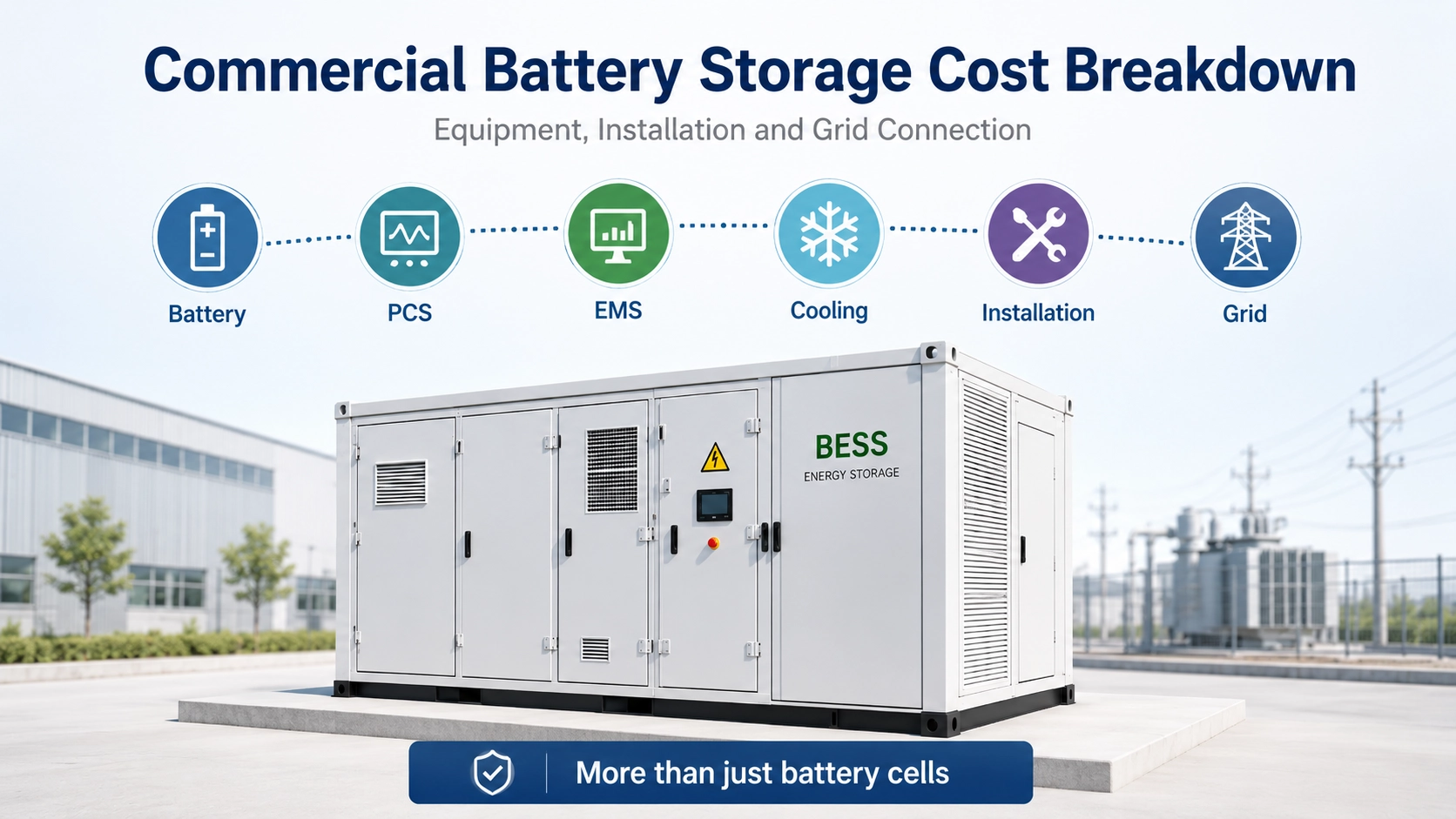
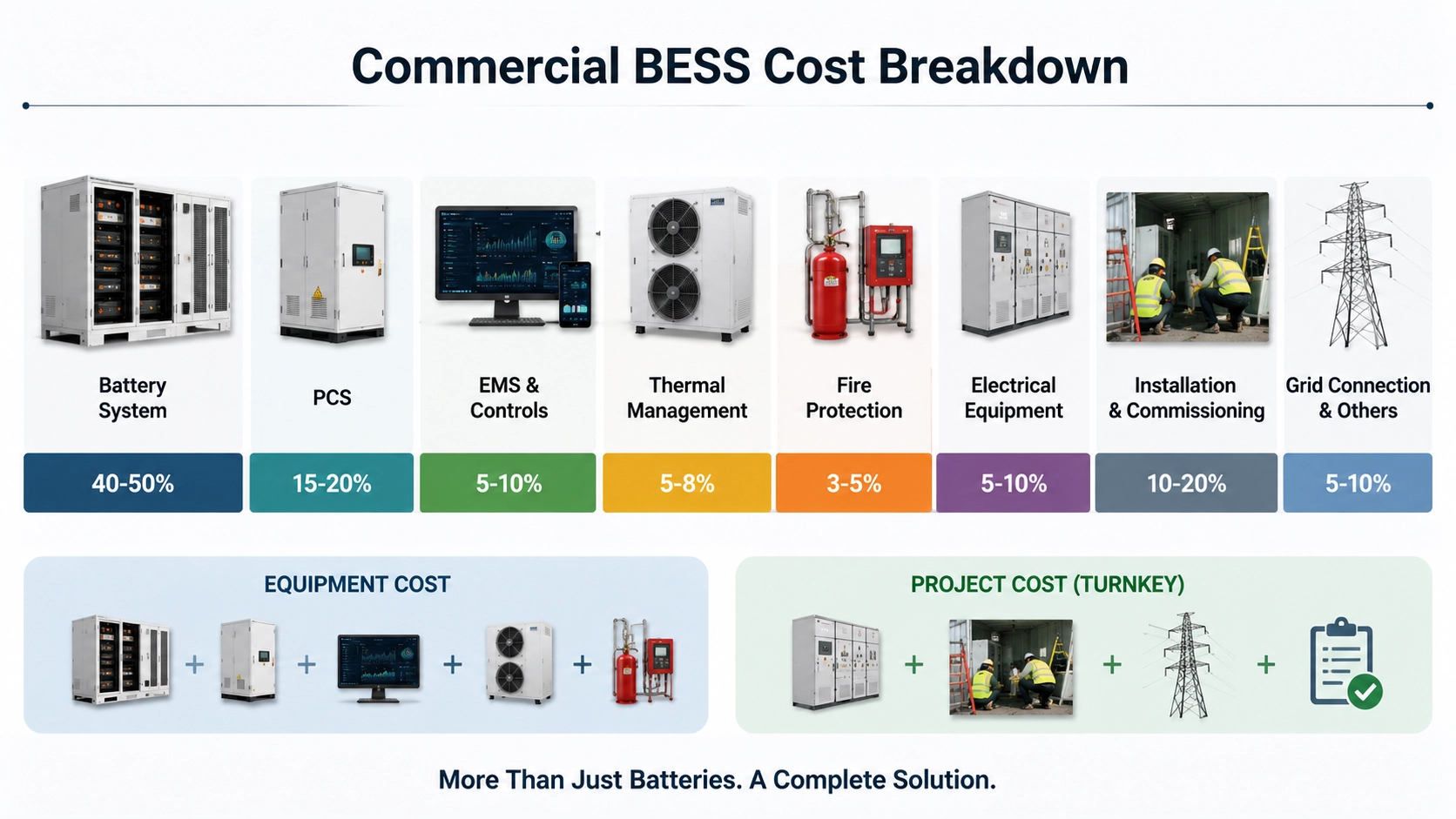
The total cost of a commercial BESS normally includes the battery system, PCS, EMS, thermal management, fire protection, electrical equipment, transport, installation, commissioning and grid connection.
For this reason, the equipment price and the fully installed project price should never be treated as the same number.
Why Commercial BESS Prices Vary So Much
Commercial battery storage systems are not standard consumer products with one fixed retail price.
The cost depends on the size of the system, how quickly it must charge or discharge, the installation environment and the work required to connect it safely to the facility.
The main factors include:
- Battery capacity in kWh or MWh
- PCS power in kW or MW
- Required operating duration
- Battery chemistry and cell quality
- Air cooling or liquid cooling
- Indoor, outdoor or containerized installation
- Fire protection and safety requirements
- Transformer and switchgear requirements
- Local labor and construction costs
- Shipping, import duties and taxes
- Grid connection and certification requirements
- Warranty length and performance guarantees
This is why comparing quotations only by dividing the total price by the battery capacity can sometimes be misleading.
A lower price per kWh may exclude the PCS, transformer, installation or commissioning. Another quotation may appear more expensive because it includes most of the equipment needed to operate the project.
Equipment Price vs Fully Installed Project Cost
Before comparing prices, check exactly what each supplier is quoting.
Equipment-Only Price
An equipment-only quotation may include:
- Battery cabinets or battery container
- Battery management system
- PCS
- EMS or system controller
- Cooling system
- Integrated fire protection
It may not include transport, foundations, cables, transformer equipment, installation or local commissioning.
Delivered Equipment Price
A delivered price may include international shipping and delivery to a port or project location, but local unloading, construction and electrical work may still be excluded.
Fully Installed Cost
A fully installed project price may include most or all of the following:
- BESS equipment
- Shipping and insurance
- Import duties and local taxes
- Concrete foundation
- AC and DC cabling
- Transformer and switchgear
- Protection equipment
- Installation labor
- Testing and commissioning
- Grid interconnection work
- Local permits and engineering
When discussing BESS cost per kWh, always ask whether the figure refers to battery equipment, the complete BESS package or the final installed project.
What Makes Up the Cost of a Commercial BESS?
1. Battery System
The battery is normally one of the largest parts of the equipment cost. It includes more than individual cells.
A commercial battery system may contain:
- Lithium battery cells
- Battery modules
- Battery racks
- High-voltage boxes
- Battery management system
- Electrical protection
- Cabinet or container enclosure
Cell price is important, but it does not represent the cost of a complete commercial battery system.
Cell consistency, cycle life, thermal performance and warranty conditions can also affect price. A cheaper battery may not offer the same usable life or performance guarantee.
2. Power Conversion System
The PCS converts electricity between the battery's DC power and the facility's AC power.
Its cost is mainly affected by:
- Putere nominală
- Grid voltage
- On-grid or off-grid operation
- Capacitate de suprasarcină
- Parallel operation
- Black-start capability
- Required communication functions
Two systems with the same battery capacity can have different costs if one uses a 100kW PCS and the other uses a 250kW PCS.
3. EMS and Control System
The energy management system decides when the battery should charge or discharge.
For a simple backup application, the control logic may be relatively straightforward. For peak shaving, solar self-consumption or microgrid operation, the EMS may need to coordinate:
- Utility grid power
- Solar generation
- Facility load
- Battery state of charge
- Diesel generators
- Electricity tariff periods
The software and controls may represent a smaller part of the total price, but they have a major effect on whether the system creates useful savings.
4. Cooling and Fire Protection
Commercial batteries need stable temperature control and suitable safety systems.
Smaller systems may use air cooling, while higher-density or frequently cycled systems may use liquid cooling.
The system may also include:
- Temperature and smoke detection
- Gas detection
- Fire alarms
- Automatic fire suppression
- Ventilation or explosion-relief design
- Emergency shutdown controls
These systems add cost, but they should not be treated as optional extras in a commercial installation.
5. Transformer and Switchgear
The BESS output voltage must match the facility's electrical system.
A smaller low-voltage system may connect directly to existing switchgear. A larger BESS may require:
- A dedicated transformer
- Medium-voltage switchgear
- Protection relays
- Metering equipment
- A new grid connection panel
This part of the project can materially increase the installed cost, especially when the existing transformer or switchgear does not have enough spare capacity.
6. Installation and Civil Work
Even an outdoor all-in-one cabinet needs a suitable installation area.
Site work may include:
- Ground preparation
- Concrete foundation
- Drainage
- Protective fencing
- Cable trenches
- Crane unloading
- Electrical installation
- Testing and commissioning
A simple installation next to an existing electrical room may cost much less than a project located far from the main transformer.
How System Size Affects BESS Cost
Larger systems normally benefit from economies of scale. The cost per kWh often falls as battery capacity increases because some expenses do not rise in direct proportion to system size.
For example, both a small and a large project may require:
- Engineering work
- Communication equipment
- Site mobilization
- Commissioning
- Grid protection studies
These fixed project costs are spread across more stored energy in a larger system.
However, a larger system is not automatically better value. The battery should still match the actual load and operating purpose.
Before estimating cost, it is useful to calculate how much PCS power and battery capacity the project really needs. Our commercial BESS sizing guide explains the basic calculation.
Why Storage Duration Changes the Price
A BESS is usually described using both power and energy, such as:
- 100kW/200kWh
- 250kW/500kWh
- 500kW/2MWh
The relationship between power and energy determines the storage duration.
De exemplu:
- 100kW/100kWh is roughly a one-hour system.
- 100kW/200kWh is roughly a two-hour system.
- 100kW/400kWh is roughly a four-hour system.
Increasing the duration adds more battery capacity, but the PCS power may stay the same.
This means the total project price rises, while some non-battery components do not need to double. As a result, the cost per kWh may be lower for a longer-duration system, even though the total investment is higher.
Indicative Commercial BESS Price Ranges
The following figures are broad planning estimates rather than fixed quotations. Actual pricing can change based on the country, system specification, supplier scope, shipping, tariffs and site conditions.
| Example System | Typical Application | Indicative Equipment Range |
|---|---|---|
| 50kW/100kWh | Small commercial backup or solar shifting | Approximately USD 30,000–60,000 |
| 100kW/215kWh | Hotel, small factory or commercial building | Approximately USD 55,000–100,000 |
| 125kW/261kWh | Peak shaving and commercial backup | Approximately USD 65,000–120,000 |
| 250kW/500kWh | Factory peak shaving or industrial backup | Approximately USD 120,000–230,000 |
| 500kW/1MWh | Large factory or commercial microgrid | Approximately USD 220,000–450,000 |
| 500kW/2MWh | Longer-duration industrial storage | Approximately USD 380,000–750,000 |
These ranges are intended only to help with early-stage budgeting. They may represent integrated equipment packages rather than complete turnkey project costs.
Local transformer work, construction, grid connection, taxes and installation can add substantially to the final amount.
Recent industry research confirms that battery storage costs have continued to decline, although the rate and final project cost vary by market, duration and project configuration. NREL therefore publishes cost projections as complete system costs per kWh rather than treating battery pack cost as the whole project cost. :contentReference[oaicite:1]{index=1}
Why a 100kWh System Can Cost More per kWh
Customers sometimes expect a 100kWh system to cost exactly one-tenth of a 1MWh system. In practice, it often costs more per kWh.
A small commercial system still needs:
- A cabinet or enclosure
- A battery management system
- A PCS
- Răcire
- Fire protection
- Controls
- Installation and commissioning
These basic components are required even when the battery capacity is relatively small.
A larger project can spread these fixed costs across more battery capacity, which is why its cost per kWh may be lower.
Low-Cost Quotation or Incomplete Quotation?
A very low price is not always a better deal. Sometimes it simply means that important items have not been included.
Before comparing two proposals, check whether both include the same scope.
| Item to Check | Questions to Ask |
|---|---|
| Capacitatea bateriei | Is the quoted value nominal capacity or usable capacity? |
| PCS | Is it included, and what is its continuous power rating? |
| Răcire | Is the system air-cooled or liquid-cooled? |
| Fire protection | What detection and suppression equipment is included? |
| EMS | Can it perform peak shaving, solar control and generator coordination? |
| Transformator | Is a transformer included in the price? |
| Shipping | Does the price include delivery, insurance and unloading? |
| Installation | Who provides cables, foundations and electrical work? |
| Commissioning | Is remote or on-site commissioning included? |
| Garanție | What capacity retention and cycle conditions apply? |
Comparing the same technical scope is more useful than comparing only the final number on the first page of a quotation.
How to Estimate the Return on a Commercial BESS
A battery system should not be evaluated only by its purchase price. The more important question is how the system will create value during operation.
Possible sources of savings include:
- Reducing demand charges
- Charging during low-tariff periods and discharging during high-tariff periods
- Using more solar energy on site
- Reducing diesel generator operation
- Avoiding production losses during outages
- Supporting EV charging without immediately increasing grid capacity
A simple payback calculation is:
Simple Payback Period = Total Project Cost ÷ Annual Financial Benefit
For example, assume a commercial battery project costs USD 300,000 and creates estimated annual savings of USD 60,000:
USD 300,000 ÷ USD 60,000 = 5 years
This simple calculation is useful for an initial check, but a full financial model should also consider:
- Battery degradation
- Electricity price changes
- Maintenance costs
- Financing costs
- Replacement parts
- Residual value
- Taxes and incentives
Example: Peak Shaving Project
Consider a factory that wants to reduce a 200kW peak lasting approximately two hours.
A possible starting configuration may be:
- PCS power: around 200kW
- Battery capacity: around 500kWh
Assume the equipment and local project work bring the total investment to USD 200,000.
If the system saves USD 35,000 each year through lower demand charges and energy shifting:
USD 200,000 ÷ USD 35,000 = approximately 5.7 years
The real result depends heavily on the electricity tariff and how often the battery can be used.
A factory with a high demand charge may achieve a much faster return than a facility that pays mostly for total energy consumption.
For more background on this application, read how energy storage can reduce demand charges.
Example: Backup Power Project
Backup projects need to be assessed differently because some of their value comes from avoiding losses rather than lowering the electricity bill.
Suppose a food processing facility loses USD 20,000 in products and production every time a long outage occurs.
If a battery system prevents several such losses during its lifetime, part of its value comes from business continuity.
For hospitals, cold storage facilities, hotels and manufacturing plants, this avoided-loss value can sometimes be more important than energy arbitrage.
When Is Commercial Battery Storage Worth It?
A commercial BESS is more likely to make financial sense when the facility has one or more of the following conditions:
- High demand charges
- A large difference between peak and off-peak electricity prices
- Frequent grid outages
- Expensive diesel generator operation
- Excess daytime solar generation
- Limited grid connection capacity
- Critical loads that cannot tolerate interruption
The business case may be weaker when electricity prices are flat, outages are rare and the battery has no clear daily operating purpose.
In that situation, installing a large system simply because battery prices are falling may not produce a good return.
How to Get a More Accurate BESS Cost Estimate
A supplier can normally provide a more useful estimate when the project information includes:
- Required PCS power
- Required battery capacity
- Backup time or peak shaving target
- Grid voltage and frequency
- Project country and installation location
- Indoor or outdoor installation
- Existing transformer capacity
- Solar system size
- Load profile
- Required certifications
- Expected delivery terms
Without this information, an early quotation may only be a rough equipment estimate.
Frequently Asked Questions
How much does a 100kWh commercial battery system cost?
A complete 100kWh commercial system may broadly fall in the range of tens of thousands of US dollars. The actual price depends on PCS power, cooling, fire protection, installation scope and local electrical work.
How much does a 1MWh BESS cost?
A 1MWh commercial or industrial system may cost several hundred thousand US dollars. The final figure varies significantly depending on PCS power, equipment quality, transformer requirements, installation and the project country.
What does BESS cost per kWh mean?
It means dividing the system cost by its battery energy capacity. However, the result is only useful when the compared quotations include the same equipment and project scope.
Is the PCS included in the battery price?
Sometimes it is included in an integrated BESS quotation, and sometimes it is priced separately. This should always be confirmed before comparing proposals.
Does a longer-duration BESS cost more?
Yes, because it requires more battery capacity. However, its cost per kWh may be lower because the same PCS and some other fixed equipment can be used across a larger battery capacity.
How long does it take for a commercial BESS to pay for itself?
There is no standard payback period. It depends on project cost, electricity tariffs, demand charges, cycling frequency, outage losses and any available incentives.
Price Is Only Useful When the Scope Is Clear
The cost of a commercial battery system cannot be judged from battery capacity alone.
A meaningful comparison needs to show what is included: battery capacity, PCS power, cooling, fire protection, EMS, transformer equipment, installation, shipping and commissioning.
The cheapest quotation may leave major costs for the project owner to handle later. At the same time, the most expensive proposal is not automatically the best. The right system is one that includes the equipment the site actually needs and has a clear plan for creating value.
Start by defining the required system size and operating purpose. Once that is clear, the cost comparison becomes much easier and far more accurate.
Explore our commercial and industrial energy storage systems to compare cabinet and containerized BESS configurations.