Which Bluesun Battery Series Is Right for Your Energy Storage Project?
Explore five Bluesun lithium battery series for residential, off-grid, commercial, and industrial energy storage. Learn how to choose the right battery based on voltage, capacity, installation, and project requirements.
15/ 2026.iul.
Choosing a battery for a solar energy system is not only about finding the largest available capacity.
A small off-grid system, a residential backup installation, and a commercial energy storage project may all use LiFePO4 batteries, but they require very different voltage levels, installation methods, communication systems, and expansion options.
This is why Bluesun provides several battery series rather than using one product configuration for every project.
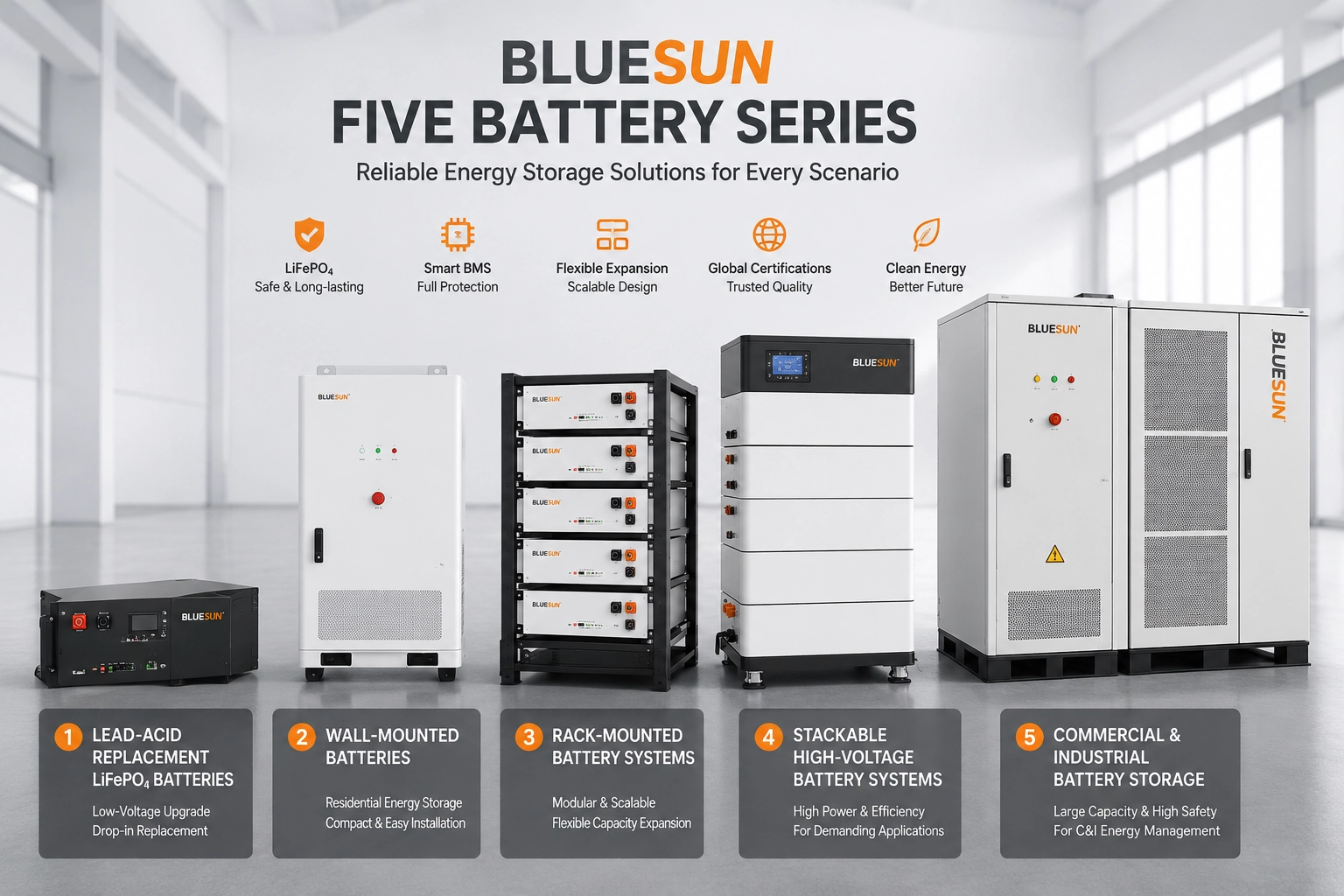
The following video introduces five main battery solution groups covering low-voltage, residential, high-voltage, and commercial energy storage applications.
One Battery Type Does Not Fit Every Project
The right choice depends on the system voltage, required storage capacity, available installation space, inverter compatibility, expected load, and whether the battery may need to expand later.
Bluesun battery solutions cover low-voltage, residential, high-voltage, and commercial energy storage applications.
Why Bluesun Offers Different Battery Series
Energy storage projects vary widely in size and purpose.
A small cabin may only need enough stored electricity for lighting and basic appliances. A family home may require a wall-mounted battery connected to a hybrid inverter. A factory may need a high-voltage system capable of supporting larger loads, peak shaving, and backup operation.
Using the same battery format for all of these applications would create unnecessary cost and installation complexity.
Bluesun therefore organizes its battery solutions around different application needs, from compact low-voltage systems to larger commercial storage projects.
1. Lead-Acid Replacement LiFePO4 Batteries
Lead-acid replacement batteries are designed for users who want to upgrade an existing low-voltage battery system without completely rebuilding the application.
They are commonly used in:
Small off-grid solar systems
Recreational vehicles and marine applications
Telecommunications equipment
Backup power systems
Existing lead-acid battery installations
Compared with traditional lead-acid batteries, LiFePO4 batteries generally provide more usable capacity, lower weight, longer cycle life, and less routine maintenance.
However, the charging voltage, current limits, and connection method should still be checked before replacing an older battery bank.
2. Wall-Mounted Batteries for Residential Storage
Wall-mounted batteries are commonly selected for homes and small commercial buildings where installation space and appearance matter.
They can be installed together with a compatible hybrid inverter to store solar electricity during the day and supply household loads after sunset or during a grid outage.
This format is often suitable for:
Home solar storage
Residential backup power
Small shops and offices
Areas with unstable electricity supply
The compact enclosure helps keep the installation tidy, while an integrated battery management system monitors voltage, current, temperature, and operating status.
3. Rack-Mounted Lithium Battery Systems
Rack-mounted batteries provide a practical option when a project requires modular capacity and organized installation inside a cabinet or equipment room.
Individual battery modules can be installed in a standard rack and combined according to the required storage capacity.
This format is frequently used for:
Case fără rețea
Telecommunications backup
Server and communication rooms
Small commercial systems
Expandable solar storage installations
One advantage of a rack-mounted design is that additional modules can often be added as energy demand increases, provided the inverter and battery communication system support the final configuration.
4. Stackable High-Voltage Battery Systems
High-voltage battery systems are designed for projects that require greater power output and more efficient operation with compatible three-phase or high-voltage hybrid inverters.
Instead of connecting many low-voltage batteries in parallel, high-voltage modules are typically connected in series to build the required operating voltage.
They are commonly considered for:
Larger residential properties
Villas and multi-family buildings
Small commercial facilities
Three-phase solar storage systems
Applications with higher power demand
Stackable construction can also simplify installation because the battery modules, control box, and base are arranged as one coordinated system.
Before selecting a high-voltage battery, the inverter voltage range, communication protocol, maximum charge and discharge current, and module quantity must all be confirmed.
5. Commercial and Industrial Battery Storage
Commercial and industrial projects require more than a larger residential battery.
Factories, warehouses, hotels, shopping centers, and industrial parks may need battery storage for peak shaving, load shifting, solar self-consumption, backup power, or a combination of several operating modes.
These projects may use outdoor cabinets or containerized systems integrating battery modules, BMS, thermal management, fire protection, PCS, and energy management functions.
Bluesun provides commercial and industrial BESS solutions for projects with different power, capacity, installation, and operating requirements.
How to Choose the Right Battery Series
The battery format should be selected only after the project requirements are clear.
Start with the Application
First determine what the battery needs to do.
A system designed mainly for emergency backup may be sized differently from one that charges and discharges every day for electricity cost reduction.
Confirm the System Voltage
The battery voltage must match the supported input range of the inverter or PCS.
Low-voltage and high-voltage batteries are not interchangeable, even when their total energy capacity appears similar.
Calculate Usable Capacity
Battery capacity should be based on actual load demand, required operating time, depth of discharge, and expected system losses.
Installing an oversized battery may increase project cost without creating additional value, while an undersized system may not support the required loads for long enough.
Check Communication Compatibility
Modern lithium batteries communicate with inverters through protocols such as CAN or RS485.
Correct communication allows the inverter to receive battery information and manage charging and discharging safely.
Plan for Future Expansion
If energy demand may increase later, a modular battery system can make expansion easier.
Expansion limits, module consistency, installation timing, and inverter capacity should still be considered during the initial design.
Safety and Battery Management Matter
Battery selection should not be based on capacity and price alone.
A reliable storage system also depends on cell consistency, enclosure design, temperature control, electrical protection, and the battery management system.
The BMS monitors important operating conditions and can limit or stop charging and discharging when abnormal voltage, current, or temperature is detected.
For larger systems, safety design may also include cabinet-level monitoring, fire protection, ventilation, liquid cooling, and communication with the EMS.
Choose the Battery Around the Project
There is no single battery series that is best for every application.
Lead-acid replacement batteries are practical for low-voltage upgrades. Wall-mounted and rack-mounted products suit many residential and small commercial installations. Stackable high-voltage systems support larger loads, while commercial BESS solutions are designed for more complex energy management requirements.
You can explore Bluesun’s wider range of lithium solar battery solutions for residential, off-grid, commercial, and industrial applications.
The most reliable result comes from matching the battery voltage, usable capacity, power output, communication method, and installation format to the real operating conditions of the project.
Frequently Asked Questions
Which battery is suitable for a home solar system?
Wall-mounted, rack-mounted, and stackable batteries may all be suitable, depending on the inverter voltage, daily electricity demand, backup requirements, and available installation space.
What is the difference between low-voltage and high-voltage batteries?
Low-voltage systems commonly operate around 48V, while high-voltage systems connect modules in series to reach a higher operating voltage. The correct type depends mainly on inverter compatibility and project power requirements.
Can lithium battery capacity be expanded later?
Many modular systems support expansion, but the maximum module quantity, inverter capacity, communication protocol, and age difference between old and new modules must be checked first.
Are residential batteries suitable for factories?
Small commercial loads may use modular residential-style batteries, but factories with larger loads or daily energy management requirements usually need purpose-designed commercial or industrial storage systems.
Can Bluesun batteries work with solar inverters?
Yes, when the battery voltage, current, and communication protocol match the inverter requirements. Compatibility should be confirmed before finalizing the system configuration.


 RO
RO  EN
EN  ES
ES  FR
FR  DE
DE  RU
RU  ZH
ZH  AR
AR  BG
BG