
 DE
DE  EN
EN  ES
ES  FR
FR  RU
RU  ZH
ZH  AR
AR  RO
RO  BG
BG 
When building a solar energy system, many people focus first on battery capacity or solar panel size. However, battery voltage is also an important part of system design.
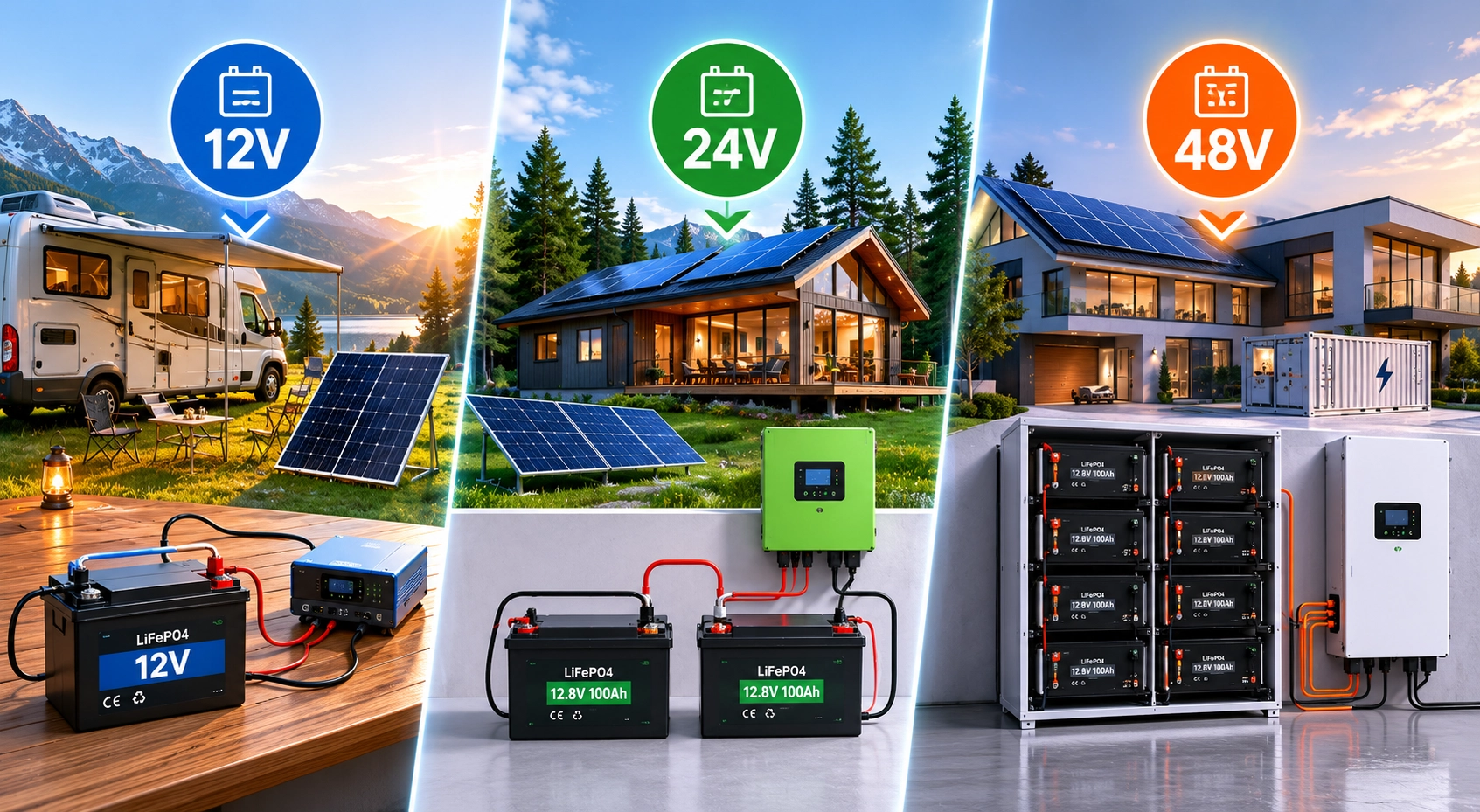
12V, 24V, and 48V battery systems are all widely used in solar applications, but they are designed for different load sizes and operating conditions.
Choosing the right voltage affects system efficiency, cable size, inverter compatibility, and future expansion flexibility.
Higher Voltage Usually Means Lower Current
For the same power output, higher-voltage systems generally use lower current, which helps reduce cable losses and improve system efficiency.
Why Battery Voltage Matters in Solar Systems
Battery voltage affects how electricity flows through the system.
Lower-voltage systems usually require higher current to deliver the same amount of power. Higher current means:
- Thicker cables
- More heat generation
- Higher transmission loss
- Lower efficiency over long cable distances
Because of this, larger solar systems often move toward higher-voltage battery configurations.
12V Battery Systems: Simple and Common for Small Loads
12V battery systems are widely used in small solar applications because they are simple and easy to install.
They are commonly used for:
- RV solar systems
- Camping setups
- Small cabins
- Lighting systems
- Portable power applications
For small loads and short cable distances, 12V systems can work very well.
However, once power demand increases, current also rises quickly, which can reduce efficiency and require much thicker wiring.
24V Battery Systems: A Balance Between Simplicity and Efficiency
24V systems are often used in medium-sized off-grid and backup power systems.
Compared with 12V systems, 24V architecture reduces current while improving efficiency and cable performance.
24V battery systems are commonly used for:
- Small off-grid homes
- Farm systems
- Backup solar systems
- Medium-load applications
For many users, 24V offers a practical balance between installation simplicity and system efficiency.
Why 48V Systems Are Becoming More Common
As solar systems become larger, 48V battery systems are becoming increasingly common.
One major reason is efficiency.
Higher voltage allows the system to deliver the same power with lower current, helping reduce cable losses and heat generation.
48V systems are commonly used in:
- Large off-grid homes
- Commercial solar systems
- Energy storage projects
- Hybrid inverter systems
- Long-duration backup systems
Many modern inverters and ESS platforms are also designed around 48V battery architecture.
As a result, 48V systems are becoming increasingly popular for expandable and long-term solar installations.
Why Larger ESS Projects Rarely Use 12V Systems
For larger solar and energy storage projects, using low-voltage battery systems becomes less practical.
As power demand increases, a 12V system may require extremely high current, which increases cable size, heat generation, and installation complexity.
This is one reason why commercial and industrial ESS projects usually use higher-voltage battery architecture.
Many modern LiFePO4 battery systems are designed for scalable 48V or higher-voltage operation to support larger loads and long-term system expansion.
How to Choose the Right Battery Voltage
The most suitable battery voltage depends on the actual application.
| Voltage | Typische Anwendungen | Main Advantage |
|---|---|---|
| 12V | RV, camping, small solar systems | Simple and easy to install |
| 24V | Medium off-grid systems, farms, backup power | Better efficiency with moderate complexity |
| 48V | Large homes, commercial ESS, hybrid systems | Higher efficiency and scalability |
When selecting battery voltage, users should consider:
- Total power demand
- Inverter compatibility
- Cable distance
- Future expansion plans
- System efficiency goals
What Many Solar Projects Are Moving Toward
As solar and energy storage systems continue growing, higher-voltage battery systems are becoming increasingly common in larger applications.
12V systems still work well for small portable and low-power setups, while 24V and 48V architectures are often better suited for larger and more expandable solar projects.
The right choice depends less on which voltage is “best” and more on which system design matches the actual energy demand and long-term usage plan.